


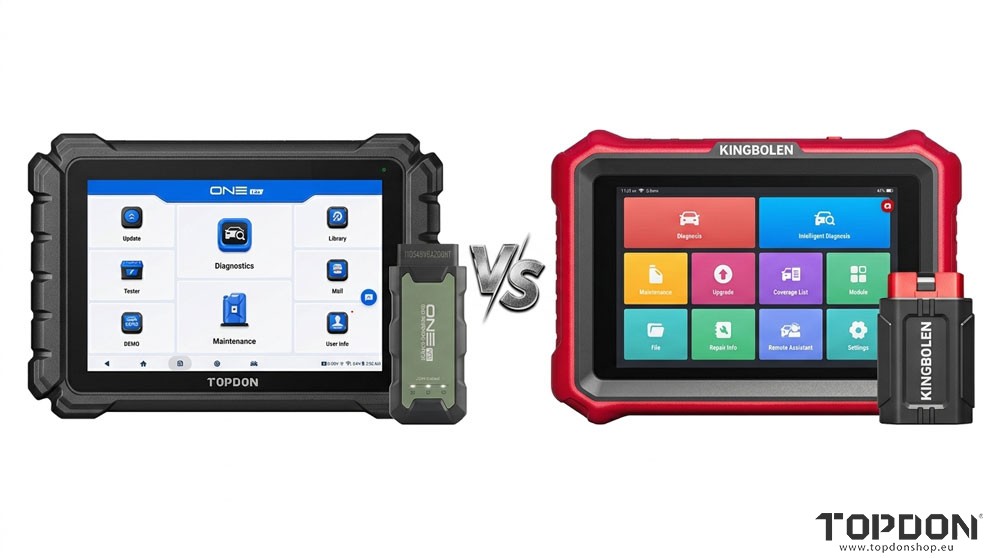
What is the difference between Topdon ONE Lite and Kingbolen K8 Pro diagnostic scanner?
Check the comparison review here.
Packaging:
The Topdon One Lite ships in a larger, wider, and taller case than the K8 Pro. Inside the Topdon case are the scan tool, a VCI, and compartments — which Jones likes because they leave room for his oscilloscope and its supporting cables — plus a separate section for accessories such as the charging block and USB cables.
Maintenance Functions
Both tools were booted up for the comparison. On maintenance functions, the Topdon One offers 50 (listed as “50 plus,” meaning more could be added), while the Kingbolen K8 Pro has 34. Which functions actually work depends on the vehicle — a car may lack a turbocharger, power seats needing calibration, or a sunroof — but many will work depending on the car.
The VCI
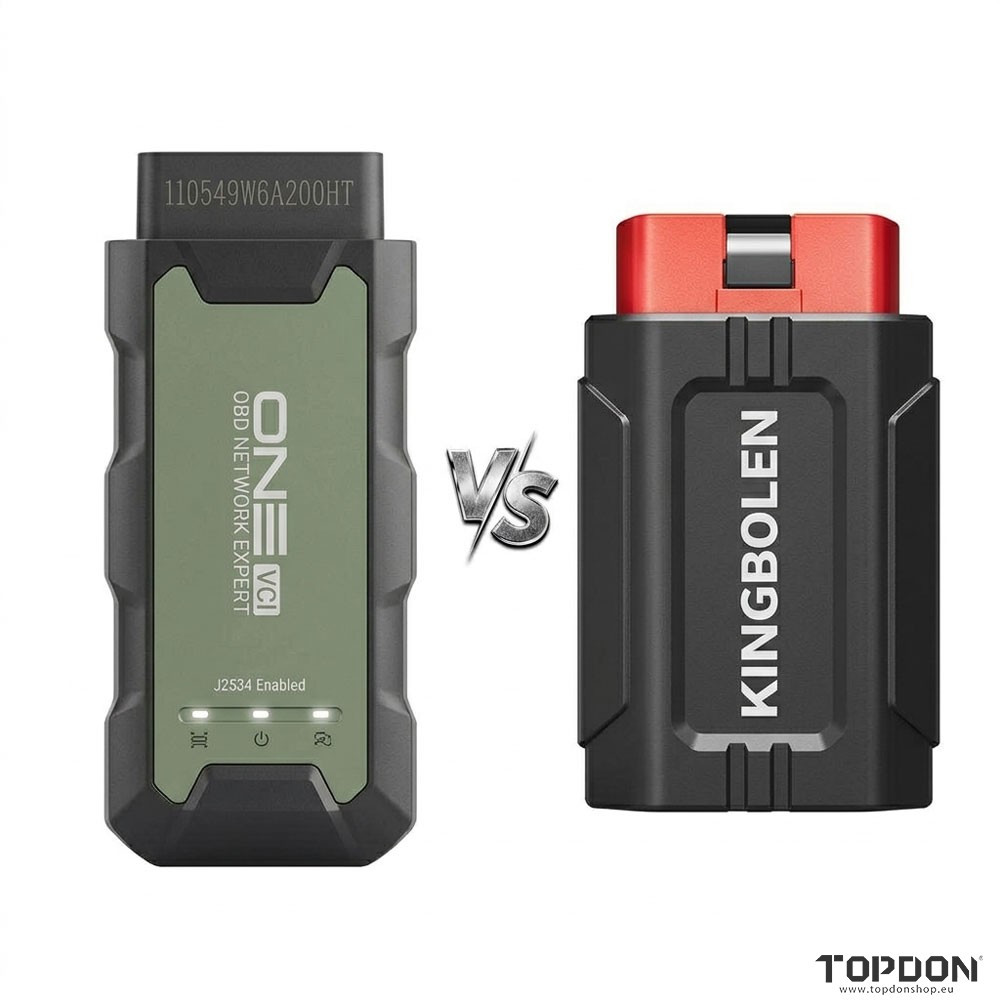
A significant hardware difference is the dongle. The Topdon One Lite’s VCI is J2534-enabled, meaning it can serve as a pass-through device for module programming, and it has been tried on 11 different OEMs. Buying a standalone J2534 device can be expensive, so this is a notable bonus — the only additional requirements being a Windows-based laptop and the programming software. The Kingbolen K8 Pro’s VCI does not offer this.
On connectivity, the Topdon One’s dongle supports both Bluetooth and Wi-Fi (either or both can be used), which extends range — useful for hooking the VCI up in the car and viewing live data from a stool nearby rather than inside the vehicle. The Kingbolen’s dongle works strictly off Bluetooth; Jones notes its stated range is about 10 meters (roughly 32 feet), and it connected fine from 10–15 feet away.
Live Data and Diagnostics Comparison
The Topdon’s network topology view as a big plus for network diagnostics: it displays the different buses (V bus, SIL bus 2, 3, and 5, and LIN bus), lets you scan individual buses, and color-codes modules — green for good, red for DTCs, gray for modules not present or not communicating. The Kingbolen K8 Pro does not have topology, though the company told him it could arrive by the end of the year.
In the A/C data stream, the Topdon displayed all the PIDs the car would provide — ambient and solar sensors, engine coolant temperature, blower motor data, servo/actuator values, evaporator fin thermistor (39°F) and target (34°F), pressure sensor readings, and electronic control valve current (about 0.8 amps, roughly 85–90% duty cycle) — with units in Fahrenheit and imperial/metric changeable via a button on the fly. Active tests included blower motor, heater level, defogger, magnetic clutch relay, and air mix servos; special functions included refrigerant gas volume check and servo motor initialization/relearn.
Switching to the Kingbolen K8 Pro, it read the same VCI over Bluetooth with no internet needed, and in the same A/C data stream it listed around 60 PIDs. Select all of them and confirmed the same readings — ambient temperature, servo data, blower speed, pressure mode, coolant temperature, evaporator values, R134a refrigerant type, and regulator pressure sensor.
Conclusion: everything the Topdon One showed, the Kingbolen showed too, “because this is what the car lets you see.” The only difference is that the Kingbolen requires going into settings to switch between imperial and metric, rather than a button.
He also relays an anecdote: on a 2004 Buick Century with a shorted 5-volt reference (brought by a friend of his youngest son), the Topdon One’s auto VIN recognized the vehicle with no problem, while another of his scan tools — not the Kingbolen — could not read the VIN and required manual entry.
Feature Comparison
Both tools have substantial batteries, full system diagnostics, bi-directional controls, CAN FD and DoIP compatibility, ECU coding, and secure gateway access (auto-auth requires an extra payment for certain makes like newer Chryslers and BMWs — without it, live data and codes still work but bi-directional functions are blocked).
Key differences:
Screen: The Topdon One Lite has a 10-inch screen.
Topology: Topdon has it; Kingbolen does not (yet).
J2534: Topdon’s VCI has it; Kingbolen’s does not.
Service functions: Topdon 50-plus vs. Kingbolen 34 (which could grow).
Top Fix AI: The Topdon One includes it — it explains codes and provides flowcharts for testing and repair. The Kingbolen does not have this, though it provides repair information and a Google button for codes.
Oscilloscope support: The Kingbolen K8 Pro supports four tools including the Thinkcar four-channel scope. The Topdon One cannot connect to Topdon’s oscilloscope. To use scope function, you need to get the Topdon ONE Pro.
Update: Kingbolen K8 Pro has free updates for lifetime. Topdon One comes with 1 year free update, then $299 per year.*
In sum:
The Topdon ONE Lite/One’s biggest advantage is its diagnostic workflow — topology, DTCs, Top Fix AI, and repair information and testing take you from complaint to scan to code to information, testing, and repair.
The Kingbolen K8 Pro’s biggest advantage is ownership cost — no fees after the initial investment, and it shows everything the Topdon shows, though diagnosis may require more research.
Read also: